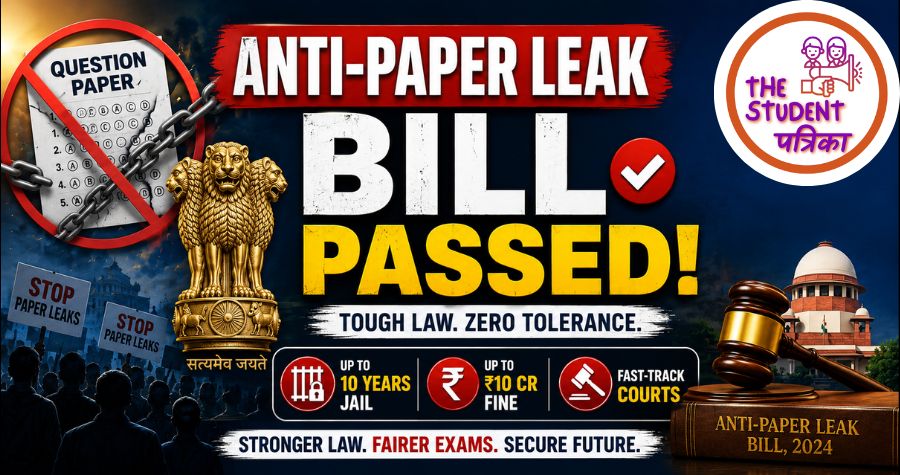
Anti - Paper Leak Bill 2026 gets Presidential Assent: Objectives, Features, 2024 vs 2026 Comparison, Pros & Challenges
Every year, millions of aspirants across India invest months, and often years of hard work preparing for national and state recruitment tests like NEET, JEE, UPSC, SSC, IBPS, and Railway exams. However, organized cheating mafias and paper leaks have repeatedly threatened to shatter those dreams, leading to sudden exam cancellations, endless court cases, and severe emotional distress for students.
To address these systemic vulnerabilities in the Indian education system, President Droupadi Murmu has officially granted Presidential Assent to The Public Examinations (Prevention of Unfair Means) Amendment Act, 2026. With this final constitutional seal, the bill passed by Parliament has officially become an enforceable law across the country.
Whether you are preparing for government job exams or national entrance tests, here is the complete analysis of this law, its objectives, strict penalties, its core advantages and limitations, to its legislative journey and a detailed comparison with the 2024 Act.
❓ Frequently Asked Questions:
-
What is the Anti-Paper Leak Law? It is a dedicated central law enacted to prevent question paper leaks, organized cheating rings, computer hacking, and impersonation across all major national examinations conducted by bodies like NTA, UPSC, SSC, IBPS, and Railway Recruitment Boards.
-
Is the Anti-Paper Leak Bill passed or not? Yes, it is now an active law. After passing the Lok Sabha on July 29 and the Rajya Sabha on July 30, President Droupadi Murmu granted official assent on July 31, 2026.
-
What is the Anti-Paper Leak Law in simple terms? It is a stringent law designed to put paper leaking mafias and corrupt private testing agencies behind bars for up to 10 years, impose fines up to ₹10 Crore, and mandate fast-track court trials within 3 months, while fully protecting honest students from criminal charges.
-
Why was the Anti-Paper Leak Bill opposed or debated in Parliament? While both Treasury and Opposition MPs agreed on protecting students, major debates arose. Opposition members demanded broader coverage for regional state selection boards, stricter regulation of private coaching hubs, and staged walkouts over police handling of student protests following recent exam irregularities.
🔍 Backstory: Why Was the 2026 Amendment Brought?
In February 2024, Parliament originally enacted the Public Examinations (Prevention of Unfair Means) Act, 2024. While it established initial penalties for exam malpractices, subsequent national exam irregularities; most notably during the recent NEET UG examination cycle, exposed operational gaps.
Investigations under the 2024 framework encountered court backlogs, and organized criminal networks continued exploiting loopholes. Following intense student agitations, the government introduced the 2026 Amendment Bill in Parliament, introducing mandatory 60 day probe deadlines and establishing dedicated fast track courts.
🎯 Objectives of the Anti-Paper Leak Bill 2026:
The primary objective of the proposed legislation is to strengthen India's legal mechanism against examination fraud by establishing severe, time bound consequences for individuals, syndicates, and service providers. Key objectives outlined in the Bill include:
- Prevent Question Paper Leaks: Eliminate instances of question paper leakage, pre-exam answer distribution, and system hacking across public examinations.
- Deter Organised Cheating: Break down criminal syndicates and organized networks through stringent prosecution and financial recovery.
- Protect Genuine Aspirants: Safeguard the interests of deserving, hard-working candidates by ensuring fair and merit based recruitment processes.
- Enhance Institutional Accountability: Fix administrative responsibility on testing agencies, examination authorities, and third-party service providers.
- Upgrade Digital Security: Promote encrypted transmission and advanced cybersecurity protocols across the testing lifecycle.
⚔️ Public Examinations Act 2024 vs. 2026 Amendment Act
The 2026 Amendment significantly sharpens the provisions of the original 2024 Act:
-
Penalties for Individual Fraudsters / Leakers: Under the 2024 Act, offenders faced 3 to 5 years of imprisonment and fines up to ₹10 Lakh. The 2026 Act increases this to 5 to 10 years of imprisonment and raises the maximum fine up to ₹50 Lakh.
-
Penalties for Service Providers & Private Vendors: The 2024 Act imposed fines up to ₹1 Crore and a 4 year debarment. The 2026 Act increases the maximum fine to ₹5 Crore and doubles the debarment period from public exams to 8 years.
-
Organized Crime Syndicates: The 2024 Act penalized organized cheating syndicates with 5 to 10 years in jail and a ₹1 Crore fine. The 2026 Act elevates this to 7 to 10 years in jail and sets a strict minimum fine of ₹10 Crore, along with property attachment of convicted offenders.
-
Investigation Timeline: The 2024 Act relied on standard police procedures without fixed statutory timelines. The 2026 Act introduces a strict 60 days (2 month) mandatory deadline for law enforcement agencies or Central Special Task Forces (STF) to complete investigations.
-
Court Trials & Disposal: The 2024 Act utilized regular Session Courts. The 2026 Act mandates that States and Union Territories designate Special Fast Track Courts for day to day trials, targeting complete case disposal within 3 months of chargesheet filing.
📜 How a Bill Becomes an Act in India? Legislative Journey:
It's important to understand the step by step constitutional procedure through which a proposed law (Bill) transforms into an enforceable Statute (Act) under the Indian Parliamentary system:
- Drafting Stage: The Ministry of Personnel, Public Grievances and Pensions drafts the legislation in consultation with legal and testing experts.
- First Reading (Introduction): Union Minister Dr. Jitendra Singh officially introduced the Bill in the Lok Sabha on July 27, 2026.
- Second & Third Reading (Lok Sabha): Members debated individual clauses before the Lok Sabha officially passed the Bill on July 29, 2026.
- Passage in Second House (Rajya Sabha): The Bill was transmitted to the Rajya Sabha, where it was debated and passed on July 30, 2026.
- Presidential Assent: President Droupadi Murmu officially granted assent on July 31, 2026.
- Gazette Notification: Upon Presidential assent, the Act is published in the Gazette of India, transforming the bill into an actively enforceable law.
⚖️ Pros and Cons of the Anti - Paper Leak Law:
🟢 The Pros (Major Benefits):
- Severe Financial & Legal Deterrent: Minimum fines of ₹10 Crore and up to 10 years in prison eliminate the profit motive for organized criminal networks.
- Time Bound Fast Track Trials: Capping police probes at 60 days and trials at 3 months ensures swift justice and prevents cases from lingering for years.
- Recovery of Exam Costs: Financial losses caused by exam cancellations can be directly recovered from guilty vendors and syndicates.
- Exemption for Honest Candidates: Innocent candidates facing localized testing glitches remain governed by administrative exam rules rather than criminal charges.
🔴 The Cons (Operational Challenges & Implementation Hurdles):
- Judicial Infrastructure: Setting up fast-track courts across all states requires substantial judicial infrastructure, additional judges, and specialized staff to avoid adding to existing court backlogs.
- Uniform Implementation Across States: Variations in state-level enforcement capacity, police resources, and administrative coordination can lead to uneven implementation.
- Investigative Capacity: Meeting the strict 60-day investigation deadline requires equipping police agencies with advanced cyber-forensic tools to trace encrypted digital paper trails.
- Addressing Root Causes: Stricter criminal laws must be paired with internal institutional reforms within testing bodies (NTA, UPSC, SSC) to fix internal security loopholes.
💡 What This Means for Aspirants?
With Presidential Assent granted, The Public Examinations (Prevention of Unfair Means) Amendment Act, 2026 is officially the law of the land. By enforcing 60 day investigation deadlines, creating fast-track courts, and establishing heavy financial penalties, the law works to ensure that your preparation leads to a completely fair, merit based outcome.
The Public Examinations law serves as a crucial shield for millions of dedicated students across India. By targeting criminal syndicates, holding private testing vendors strictly accountable, and speeding up judicial trials, the legislative framework aims to ensure that your years of hard work lead to a completely fair, merit-based outcome.
What are your thoughts on this new law receiving the President's assent? Share your opinions in the comments below!
Want instant alerts on exam schedules, answer keys, and verified government updates? Join our official Student Patrika Telegram or WhatsApp Channel right now for real-time, completely verified updates directly on your phone! 📲
Related Post


Comments
Advertisement