Parliament Monsoon Session 2026: Key Bills Passed, Major Debates & Highlights
The Monsoon Session of the Indian Parliament (held from July 20 to August 13, 2026) has officially concluded. Across 19 intensive sittings, both the Lok Sabha and Rajya Sabha engaged in crucial legislative business, major political debates, and the passage of landmark statutes. The session covered major reforms in judicial administration, state nomenclature, anti-corruption mechanisms, digital evidence rules, mining laws, cooperative sector financing, and student examination integrity.
For students and aspirants preparing for competitive examinations such as UPSC, SSC CGL, State PSCs, and law entrances, tracking parliamentary proceedings and newly passed statutes is essential for the Current Affairs and Indian Polity modules.
Here is the comprehensive breakdown of the key bills, major discussions, political debates, and essential exam facts from the Monsoon Session 2026 on Student Patrika.
Monsoon Session 2026: Overall Snapshot
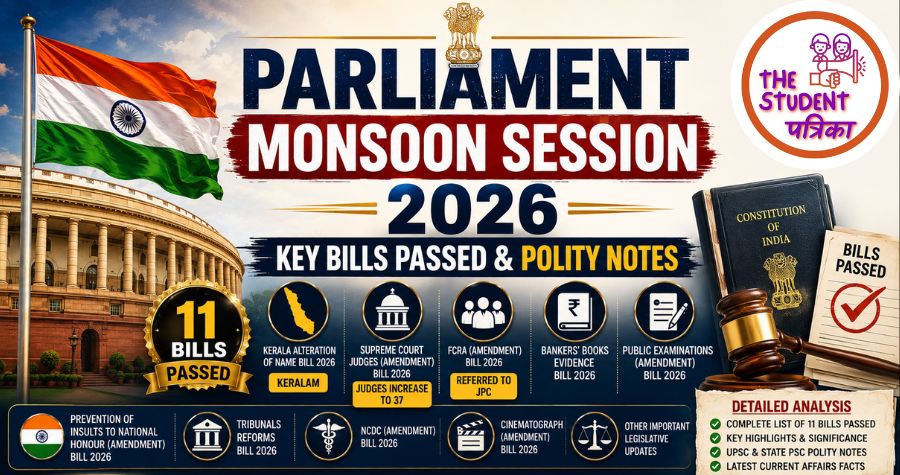
During the session, the government introduced 12 Bills, out of which 11 were successfully passed across both Houses before Parliament adjourned sine die on August 13, 2026.
Key Highlights:
- Session Duration: July 20, 2026 - August 13, 2026
- Bills Introduced: 12 Bills
- Bills Passed: 11 Bills passed across both Houses (including key amendments to existing statutes and constitutional schedule alterations)
- Key Reference to Joint Parliamentary Committee (JPC): The Foreign Contribution (Regulation) Amendment Bill, 2026, was referred to a 20 member Joint Parliamentary Committee (10 MPs from Lok Sabha and 10 MPs from Rajya Sabha) for clause by clause scrutiny.
Key Bills Discussed and Passed in Parliament:
1. The Kerala (Alteration of Name) Bill, 2026
- The Bill officially changes the name of the state of "Kerala" to "Keralam" in the First Schedule of the Constitution of India. This follows two unanimous resolutions passed by the Kerala State Legislative Assembly (in August 2023 and June 2024) requesting the Union Government to align the state's official constitutional name with its traditional Malayalam pronunciation.
- Under Article 3 of the Constitution of India, Parliament holds exclusive power to form new states, alter state boundaries, or change the name of any existing state. A Bill seeking a name change can only be introduced on the prior recommendation of the President of India. The President refers the proposed draft to the concerned State Legislature to express its views within a specified period.
2. Public Examinations (Prevention of Unfair Means) Amendment Bill, 2026
- Amends the baseline Public Examinations Act, 2024 to introduce stricter, time bound legal mechanisms against organized paper leaking mafias, computer hacking syndicates, and compromised testing agencies.
- Mandates a statutory 60 day deadline for law enforcement agencies and Special Task Forces (STFs) to complete investigations into paper leak cases.
- Directs States and UTs to set up Special Fast Track Courts operating on a day to day trial basis, targeting complete case disposal within 3 months.
- Imposes 7 to 10 years of imprisonment and minimum fines of ₹10 Crore on organized crime syndicates, along with property attachment and complete exam cost recovery from guilty third party service providers.
3. Supreme Court (Number of Judges) Amendment Bill, 2026
- Amends the Supreme Court (Number of Judges) Act, 1956, to expand the sanctioned judicial capacity of India's apex court.
- Increases the maximum number of Supreme Court judges from 33 to 37 (excluding the Chief Justice of India) to tackle case backlogs and expedite constitutional bench hearings.Including the CJI, the total sanctioned judicial strength of the Supreme Court now stands at 38 judges (37 + 1).
- Parliament derives its power to fix the number of Supreme Court judges under Article 124(1) of the Constitution. This expansion directly addresses the mounting pendency of over 80,000 cases and allows the Supreme Court to constitute dedicated Constitutional Benches (5 judges or more) without stalling routine appellate benches.
4. Mines and Minerals (Development and Regulation) Amendment Bill, 2026
-
Introduces private sector exploration licenses for deep seated and critical strategic minerals (such as Lithium, Cobalt, Nickel, and Rare Earth Elements), streamlines competitive auction mechanisms, and mandates environmental restoration funds.
5. National Co-operative Development Corporation (Amendment) Bill, 2026
- Amends the National Co-operative Development Corporation Act, 1962.
- Expands the operational mandate and financial powers of the NCDC (a statutory body under the Ministry of Cooperation). It enables NCDC to provide direct, faster, and flexible working capital loans, equity participation, and international line-of-credit support to cooperative societies across agriculture, dairy, fisheries, and rural credit sectors.
6. Tribunals Reforms Bill, 2026
- Seeks to streamline the composition, appointment criteria, service qualification, search/selection committees, and tenure conditions for tribunal chairpersons and members, across various administrative and appellate tribunals.
- Fixes uniform tenure conditions (typically 4 years or until reaching specified age limits) for Tribunal Chairpersons and Members, aiming to reduce executive interference and accelerate judicial efficiency.
7. Income Tax (Amendment) Bill, 2026
- Replaces the Income Tax (Amendment) Ordinance, 2026.
- Grants targeted tax exemptions, certainty on capital gains, and simplified withholding rules for specified Foreign Institutional Investors (FIIs), Sovereign Wealth Funds, and global pension funds investing in Indian government bonds and sovereign debt securities.
8. Bankers' Books Evidence Bill, 2026
- Repeals and replaces the outdated Bankers' Books Evidence Act, 1891, modernizing the legal framework governing financial evidence in judicial proceedings.
- Legally recognizes electronic databases, cloud storage logs, digital transaction ledgers, core-banking software records, and virtual statements as primary evidence in courts.
- Eliminates the requirement for bank officers to physically appear in court to authenticate routine digital printouts, drastically speeding up economic offense trials and civil recovery suits.
- Connects directly with Indian Evidence Law reforms (Bharatiya Sakshya Adhiniyam) and financial sector digitisation.
Major Political Discussions & Parliamentary Debates:
Referral of FCRA Bill to Joint Parliamentary Committee (JPC): The Foreign Contribution (Regulation) Amendment Bill, 2026, which proposes strict rules for freezing, managing, and disposing of assets belonging to non-governmental organizations (NGOs) whose FCRA licenses have been suspended or cancelled; faced intense debate. Following motions adopted in both Lok Sabha and Rajya Sabha, the Bill was officially referred to a 20 member Joint Parliamentary Committee (JPC). A Joint Parliamentary Committee is an ad-hoc committee set up for a specific purpose to examine a complex bill or issue. It comprises members from both Houses in a 2:1 ratio (twice as many MPs from Lok Sabha as from Rajya Sabha).
Heated Debates on Student Protests & Exam Integrity: Parliamentary proceedings saw sharp exchanges regarding recent student agitations over competitive entrance examinations. While the Opposition demanded extended debates on national testing mechanisms, Union Ministers highlighted that the passage of the Public Examinations (Prevention of Unfair Means) Amendment Bill, 2026 represented a concrete, permanent legislative solution to protect student futures.
Key Takeaways:
- Supreme Court Judge Strength: Increased from 33 to 37 (excluding CJI).
- State Name Change: Kerala renamed to Keralam via constitutional amendment process.
- Digital Evidence in Banking: Bankers' Books Evidence Bill recognizes cloud and digital records as primary evidence.
- Cooperative Funding Body: NCDC operates as a statutory body under the Ministry of Cooperation.
📢 Join Student Patrika for Daily Current Affairs!
Stay updated on every parliamentary update, scheme launch, and exam notification without missing a beat!
💬 What is your opinion on the bills passed in this session? Which legislation do you think will impact students the most? Drop your thoughts in the comments below!
📲 Join our official Student Patrika Telegram or WhatsApp Channel right now for real time, completely verified updates directly on your phone!
Related Post


Comments
La práctica responsable del juego consiste en un enfoque mediante el cual tiene como objetivo conservar el equilibrio respecto a el juego y evitar los daños potenciales vinculados con el juego. Requiere fijar límites de dinero al momento de participar, y también identificar los indicios que indican una conducta problemática. https://www.apkfiles.com/apk-622658/descargar-mobcash-apk-oficial-gesti-n-de-caja-m-vi Además, impulsa decisiones responsables así como pretende que el esparcimiento continúe siendo el objetivo central de el juego. Para decirlo de otro modo, este enfoque permite a los jugadores a conservar el dominio sobre sus hábitos así como a gozar el juego de forma segura.
Advertisement